Feline distemper is the common name for the feline panleukopenia virus (fpv), which is sometimes called feline parvovirus. To protect your dog against distemper,parvo and other diseases the dog must also be vaccinated agaist those.

We’re Changing Things! But Now It’s Winter And Funds For
By definition, distemper is a viral virus and it typically infects nocturnal animals like raccoons.

Distemper vs rabies. Companion ferrets need to be vaccinated against 2 viral diseases that cause neurologic illness: In many cicumstances, veterinarians are requiring to be able to administer rabies vaccine in dogs at the same time as vaccinating against canine distemper, adenovirus, parvovirus, parainfluenza. Distemper, meanwhile, comes in two forms:
Frequently these are given in a combination shot,so your dog only has to get poked once to be protected from up to 7 diseases. Histopathology confirmed pulmonary edema and enteritis consistent with distemper, although no inclusion bodies were seen and ihc on the lung samples was negative. Compatibility between a rabies vaccine and a combined vaccine against canine distemper, adenovirosis, parvovirosis, parainfluenza virus and leptospirosis.
When they contract it, these animals will become abnormally active during the day. Rabies, canine distemper, and canine parvovirus exposure in large carnivore communities from two zambian ecosystems vector borne zoonotic dis. Although not common in ferrets, both viruses are fatal in ferrets and rabies virus is also fatal in humans.
Typically, the rabies vaccine is administered to pets in a separate injection at the same time as the canine distemper combination vaccine. Rabies testing was negative, while the canine distemper fa and pcr were both positive. Because surely there is multiple compounds hidden in the vaccine you're about…
Rather, fpv causes serious disease in infected cats and can be fatal. What are feline distemper and rabies? Most important question is what is in the vaccine?
Rabies is a 100% fatal disease of mammals. Canine distemper is a contagious and serious viral illness with no known cure. How often does my pet need the distemper/parvo vaccination?
Work continues on the cabin foundation, and i also show footage, taken f. Rather, fpv causes serious disease in infected cats and can be fatal. 2006), and rv also poses an important human.
Allergic reactions to vaccines some of the most common allergic reactions to vaccines are hives, itching, breathing difficulties, low blood pressure, low blood oxygen, even seizures. What are feline distemper and rabies? While rabies poses a potential health threat to human beings, distemper does not.
Ferret's have two types of vaccinations, against canine distemper and against rabies. In this article, we provide a basic review of the 2 diseases, highlighting key neurologic concerns. Not sure exactly what these diseases are?
It’s not really rabies — it’s distemper,” he said. Virginia law does not require distemper shots, unlike the rabies vaccine, but they are available. A brain sample was submitted for rabies fa, and lung and bladder were submitted for canine distemper pcr and fa.
Rabies is a dangerous virus that. Rabies is a dangerous virus that infects. Despite the name feline distemper virus, infection with this virus does not affect a cat’s temperament.
This means while you are safe from distemper, your domestic animals are not, especially your dog. Authors are r berentsen 1. Despite the name feline distemper virus, infection with this virus does not affect a cat’s temperament.
Deciding whether or not to vaccinate is a very important part about owning a ferret. The rabies virus can affect any mammal, including humans. The virus can be spread through the air and by direct or indirect contact with an infected animal.
Like rabies, after the first year, distemper/parvo can be given as a 3 year vaccine, only if the pet has stayed on a veterinarian recommended vaccine. Distemper is a viral virus and it typically infects nocturnal animals like raccoons. Rabies virus (rv) and canine distemper virus (cdv) have both been implicated in significant population declines and local extinctions in wild african carnivores (gascoyne et al.
It is most common in carnivores and bats. However, the rabies vaccine can also be. It can only be passed on to other animals.
Feline distemper is the common name for the feline panleukopenia virus (fpv), which is sometimes called feline parvovirus. Symptoms of canine distemper include fever, nasal discharge, coughing, lethargy, reduced appetite and vomiting. The first vaccine typically immunizes the puppy against distemper and parvovirus, while the second is a polyvalent one, and it protects your dog against distemper, infectious hepatitis, parainfluenza, and parvovirus.
Rabies is spread through exposure to the saliva of an infected animal, and distemper is generally passed through inhalation of the virus but also can spread through contact with bodily fluids or droppings of the animal that’s infected. For both dogs and cats, veterinarians offer distemper vaccines. A good period between both vaccinations for rabies and canine distemper should be around two weeks (14 days).
As you can see, rabies and distemper can appear to be one and the same but in reality, they are quite different. Disease intervention strategies are being developed and implemented to control. Rabies vaccine,however,is always just for rabies.
Because there is no effective treatment and the disease can also infect humans, vaccination against the rabies virus is required by law in most states. We have heard about a reemergence of distemper due to pets not being vaccinated, and rabies is always a concern.
The animals is not at all aggressive, but still foams at the mouth, drools, etc. The earliest symptoms may include fever and neurological symptoms like pain, tingling, pricking, or burning (clubbed together as paresthesias) at the wound site, without obvious cause.
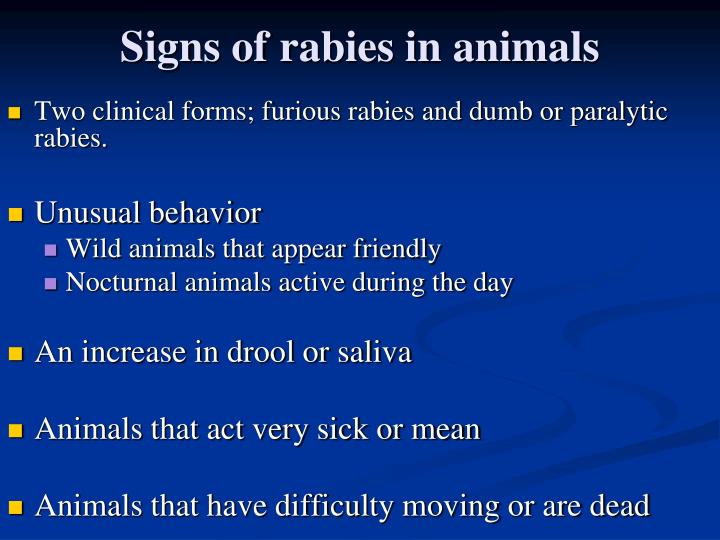
PPT Rabies PowerPoint Presentation ID3572618
Animal experts identify several telltale symptoms affecting raccoons with both types of rabies.

Dumb rabies symptoms. People can be infected by this form when examining the dog’s mouth or giving it. Rabies without evident symptoms is called “dumb rabies,” and is the most common form in dogs. Paralytic rabies, also referred to as “dumb rabies,” is the more common type in dogs.
The horse appears confused, with its jaw hanging open. Dumb rabies, often described as the paralytic form of rabies, manifests itself as paralysis of the throat and chewing muscles. Within days, encephalitis (furious rabies;
In this form, the virus travels to motor nerves which affect their functions and cause muscle paralysis to coma. The animal will walk around as if it is in a daze. There also may be discomfort, prickling, or an itching sensation at the site of the bite.
Dumb rabies occurs in approximately 20% of patients and presents with paralysis. The horse's actions are uncontrollable. It drools and acts choked.
In man, furious rabies is characterised by hydrophobia: In this form, the throat and masseter muscles become paralyzed; Dumb rabies occurs in about 20% of patients.
Furious rabies is more common and is characterized by anxiety and psychological disturbances confusion, agitation, delirium, rage, hallucinations, and hydrophobia. In 80%) or paralysis (dumb rabies; These animals may not be vicious and rarely attempt to bite.
Other neurological symptoms are due to changes in different parts of the brain, and may include: Rabies is a zoonotic disease, spread from animals to humans. The first symptoms of rabies may be similar to the flu, including weakness or discomfort, fever, or headache.
They appear in broad daylight and display unusual confidence around humans, adopting even serene and docile temperaments. Rabies is a severe viral infection of the brain and spinal cord that is transmitted by infected animals. Passive rabies is also called dumb rabies. dumb rabies is when an animals is.
Because of the paralysis, the animal may drool (“foaming at the mouth”) and display odd facial expressions. Early symptoms of rabies may be gradual and hard to spot. This is a video of.
These symptoms may last for days. Terror and excitation with spasms of inspiratory muscles, larynx and pharynx precipitated by attempts to drink and by a variety of other stimuli. Animals afflicted with dumb rabies suffer from disorientation or confusion;
Human rabies is a disease with almost 100% fatal outcome (death) usually after seven to ten days from the start of the symptoms. Dogs suffering from paralytic rabies experience weakness, loss of coordination, and eventually paralysis. Paralysis (being unable to move) symptoms usually take about 20 to 60 days to appear, however this can range from several days to many months.
Being unable to swallow properly. Furious rabies vs dumb rabies. Initial symptoms often include fever, pain, unusual or unexplained tingling, pricking or a burning sensation (paraesthesia) at the wound site.
As in canine rabies there are furious and dumb forms of the disease. Initial symptoms of rabies are nonspecific: Drooping of the lower jaw is common.
They can appear lethargic and often seem paralyzed. As the virus spreads from muscle cells at the site of inoculation through the peripheral nerves to the central nervous system, progressive, fatal inflammation of the spinal cord and subsequently, brain (encephalitis) develops. Though dogs are the main disease carriers, they are by no means the only ones, with wild bats, foxes.
Rabies takes place internationally, affecting pets and the natural world. How quickly symptoms appear partly depends on the: Paralysis often starts at the throat and jaw muscles leading to excessive salivation and difficulty swallowing.
Symptoms tend to progress quickly to weakness or paralysis of the legs, seizures, difficulty breathing, hypersalivation (too much saliva) due to difficulty swallowing, and abnormal behavior. The paralytic (“dumb”) form of rabies is characterized by progressive paralysis. Symptoms then progress to cerebral dysfunction, anxiety, confusion, and agitation.
Having one pupil larger than the other (“anisocoria”) being unable to move one or both sides of their face (“facial paralysis”) being unable to move their tongue properly. Drooping of the lower jaw can be seen. Intense itching at the site has also been reported quite often.
The furious stage demonstrates excessive salivation and abnormal aggression, with excitable and exaggerated movement. Chapter 7 viral zoonoses medical browser ? An animal with dumb rabies shows all of the same symptoms as an animal with mad rabies, except aggression.
Encephalitis causes restlessness, confusion, agitation, bizarre behavior, hallucinations, and insomnia. The dumb form of rabies presents a change in the horse's disposition or a peculiar look in the horse's eyes. There are two forms of human rabies:
The paralytic form of rabies (or dumb rabies) usually involves paralysis of the throat and jaw muscles, often with excess salivation and inability to swallow. Dumb rabies also called as paralytic rabies. The encephalitic form starts with fever, malaise, pharyngitis, and paraesthesia at the site of the bite followed by the classical neurological symptoms of hydrophobia, aerophobia, agitation, hypersalivation, and seizures.